Looking for a professional book editor for your manuscript? I provide freelance editing services for indie authors, self-published writers, and creatives who want polished, publish-ready work. From light developmental editing to copyediting and proofreading, I help authors strengthen their stories while preserving their unique voice.
You didn’t pour your heart into your manuscript just to hand it off for a surface-level polish.
You wrote it because something in you needed to say it.
Because your characters wouldn’t leave you alone.
Because your story matters.
And stories that matter deserve thoughtful, intentional editing.
That’s where I come in.
Editing That Strengthens Your Voice … Not Rewrites It
Since 2011, I’ve worked with more than 700 manuscripts across genres. Fiction. Memoir. Devotionals. Fantasy worlds. Love stories. Raw, vulnerable life stories.
My goal is never to rewrite your book into something that sounds like me.
My job is to help it sound more like you … only stronger, clearer, and more powerful.
Editing is not about stripping away your style. It’s about sharpening it.
What Makes My Editing Different
I offer a hybrid approach that blends line editing with content insight. That means we work on both:
• Sentence-level clarity and flow
• Word choice and repetition
• Grammar and mechanics
• Pacing and structure
• Character consistency
• Emotional impact
• Reader experience
You don’t just get corrections.
You get collaboration.
If something feels unclear, rushed, underdeveloped, or confusing, I explain why. If something is powerful, I’ll tell you that, too. You deserve to know what’s working just as much as what needs refinement.
For Authors Who Care About Their Craft
My clients aren’t looking for a red-pen massacre. They’re looking for growth.
They want their story to land the way they intended.
They want their message to be understood.
They want readers to stay hooked.
If that’s you, you’re in the right place.
Supportive But Honest
I believe in kindness. I also believe in clarity.
You won’t get vague feedback.
You won’t get one-line comments.
You won’t get left guessing.
You will get thorough edits, thoughtful suggestions, and clear explanations. You will get someone who respects how vulnerable it is to hand over your work.
Writing is brave. Editing should honor that.
Established, Experienced, Invested
There for You Editing has been open since October 2011.
Over 700 manuscripts edited.
More than a decade of helping authors strengthen their work before publication.
This isn’t a side hobby.
It’s my profession, and it’s personal.
Because every book represents someone who dared to create.
Ready to Work Together?
If your manuscript is complete, or close, and you’re ready for real, detailed editing that supports your voice and strengthens your message, I’d love to hear from you.
Let’s take your story from almost there to absolutely ready.
By someone who loves you enough to tell you the truth
Let’s just rip the Band-Aid off: every writer needs an editor. Yes, even the ones with degrees. Yes, even the ones who are editors themselves. And yes, even you, my talented, brilliant, spell-check-abusing friend.
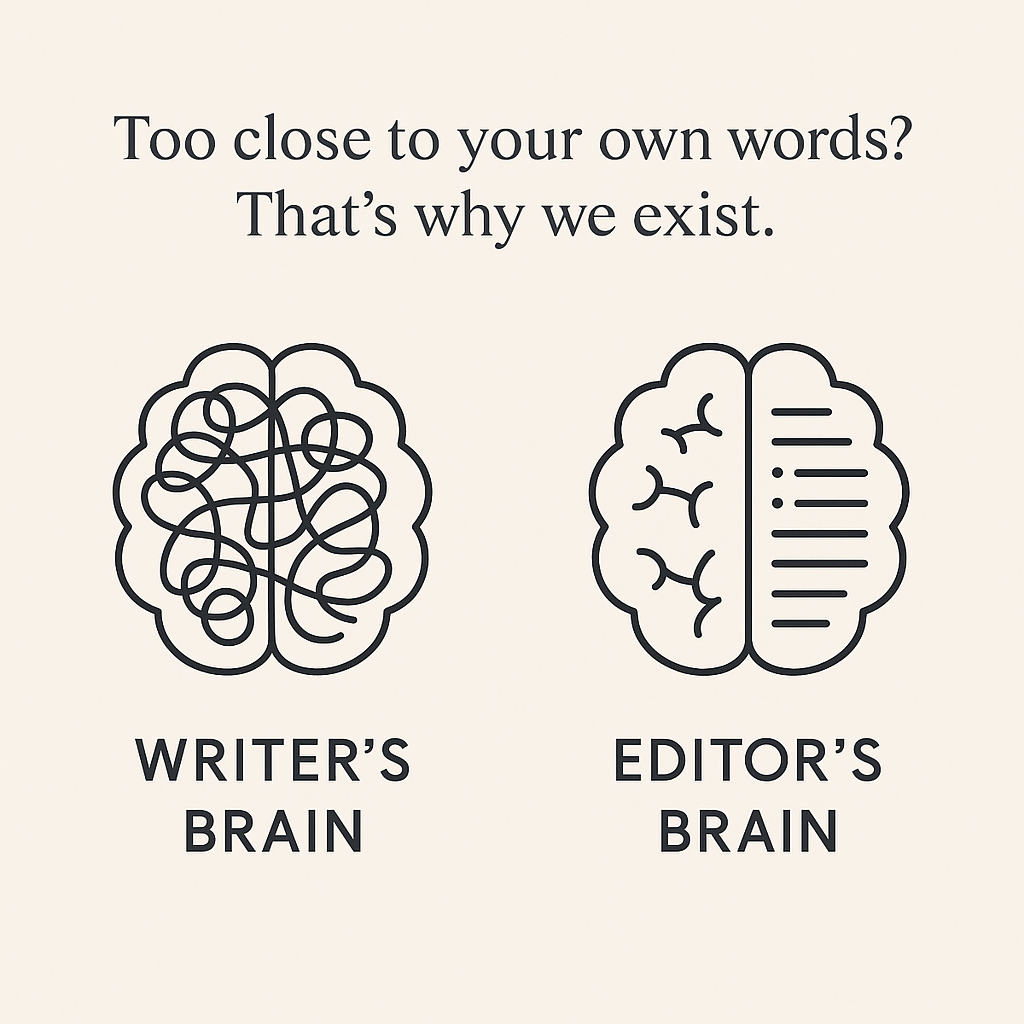
Here’s the thing: writing is emotional. It’s personal. It’s vulnerable. When you’re that close to your own words, it’s nearly impossible to spot the gaps, tangents, or scenes that only make sense in your head. That’s where an editor steps in … not to tear you down, but to build you up better.
Here’s what a good editor actually does:
Clarifies your message so your readers aren’t left saying, “Wait, what just happened?”
Catches errors your brain glosses over because it already knows what you meant (curse you, typo blindness).
Strengthens your voice without watering it down. A good editor doesn’t erase you—they amplify you.
Saves your credibility. No one wants their book baby published with homophone horror stories like “bare with me” instead of “bear with me.” (The trauma.)
Polishes your pacing, flow, and structure so your reader stays hooked, not confused or bored.
Editing isn’t about perfection, it’s about connection.
Your story might be raw, real, and powerful … but if it’s buried under clunky sentences, confusing transitions, or grammar glitches, your message gets lost. An editor helps bridge the gap between your ideas and your reader’s experience.
Because at the end of the day? It’s not about your ego. It’s about your impact.
Common excuses I hear (and lovingly demolish):
“But I’m good at grammar.” Cool! You’re still too close to your work to catch everything.
“I’ll just use AI.” AI is a tool. An editor is a human brain + a literary therapist + a plot surgeon. We see what a robot can’t.
“Editing is expensive.” So is reprinting your book with a typo on the first page.
The truth?
If you believe your words matter—if you care about your craft, your readers, and your reputation—you need an editor. Not because you’re not good enough. But because you’re too good to settle for less.
Want help making your words shine? I know a girl. Let’s turn your draft into something you’re proud to share with the world.
It’s me, your favorite emotionally exhausted rodent with a caffeine addiction and a low tolerance for nonsense, Grumpy Capy. I didn’t want to write this blog, but apparently, if I don’t show up every now and then, people start assuming I’ve “gone on a wellness retreat.” Spoiler: I have not. I’ve just been busy contemplating the abyss and side-eyeing productivity culture.
So let’s talk about something important …
Motivation? I Don’t Know Her.
Every productivity guru is out here screaming about 5 a.m. cold plunges and hustle vibes while I’m just trying to remember if I brushed my teeth or if that minty feeling is from last night’s regrets.
You want goals? Here’s mine:
Wake up. Don’t scream. Maybe respond to one email without throwing my laptop into a swamp. Eat something that isn’t passive-aggressive trail mix.
That’s growth, baby.
Self-Care? More Like “Self-Don’t-Talk-to-Me.”
I tried journaling. Got through half a page before I wrote, “This is stupid,” and drew a tiny middle finger.
I tried meditating. Immediately fell asleep and woke up angrier.
I tried yoga. Got stuck in Child’s Pose and had an existential crisis.
So now I just sit in a warm bath of sarcasm and iced coffee and call it “healing.”
To-Do List? More Like “Suggestions I Will Ignore.”
There are currently 47 tasks on my list, and you know what I did today?
I stared at them.
Then I added “stare at to-do list” to the list.
Then I checked it off.
I’m basically a productivity god.
Final Thoughts (Before I Go Hibernate Again)
Not everything has to be optimized. Not every moment has to be a lesson. Sometimes you’re just a tired, introverted capybara doing your best in a loud, emotionally draining world.
And that’s enough.
Now leave me alone … I’m busy doing nothing. It’s a full-time job.
With all the love of a half-finished iced latte and none of the patience,
Let’s get one thing straight: needing an editor doesn’t mean your writing sucks.
It means you’re smart enough to know that your words deserve a second set of eyes, and that your story deserves to shine.
You didn’t pour your heart, soul, and late-night caffeine binges into your book just to second-guess every comma, right?
That’s where There for You Editing comes in.
📣 We’re not here to tear your voice apart.
We’re here to amplify it. To polish the magic you already made. To help your message hit harder, flow better, and sound exactly like you … only sharper.
Whether you’re a first-time author, a self-publishing badass, or a spicy content creator with too many tabs open and a looming deadline, we’ve got your back.
Because editing should feel like support, not shame.
We’re here to:
•Catch your sneaky grammar gremlins
•Strengthen your voice without stripping your style
•Help you say what you actually mean with confidence
•Remind you that you’re a damn good writer, full stop.
So if you’re tired of staring at your draft like it just personally offended you …
Let us help. Because your words matter.
And we’re There for You, every sentence of the way.
Let’s be real: writing a book is hard. Publishing it? Even harder. But selling it in a world where everyone’s attention span is shorter than a TikTok? That’s a whole new beast.
So here’s the truth most authors don’t want to hear:
If you’re not showing up on social media, your book is missing out on the spotlight it deserves.
Before you panic-scroll away, take a breath. This isn’t about becoming an influencer. You don’t need to dance, lip-sync, or overshare your personal life (unless you want to … then by all means, bring the drama). But you do need to show up.
Here’s why social media matters for authors:
1. Visibility Is Everything
You could have written the next great literary masterpiece, but if no one knows it exists? Crickets. Social media helps your book be seen. It’s the digital equivalent of waving your book around in a crowded room and saying, “Hey, this might change your life.”
2. Readers Buy from People, Not Just Pages
People want to know the human behind the words. Posting on social media builds trust and connection. You’re not just a name on a cover—you’re someone they root for, laugh with, cry with, and buy from.
No need to throw thousands at ads right out the gate. With consistent posting, smart captions, and a sprinkle of personality, you can build a loyal audience organically. Bonus points if you include cat pictures. Readers love cats.
4. It Keeps You Top of Mind
A one-time post doesn’t cut it. Regular posting reminds people, “Oh right, I’ve been meaning to buy that book!” Visibility breeds familiarity, and familiarity leads to sales.
5. It’s Where Your Readers Already Are
Whether they’re scrolling through BookTok, saving aesthetic Instagram posts, or lurking in Facebook book groups—your readers are online. Meet them where they are. Then blow their minds.
Okay, but what do I even post?
I got you. Try:
•Behind-the-scenes of your writing process (yes, even the messy parts)
•Quotes from your book
•Funny or relatable author struggles
•Fan reactions and reviews
•Aesthetic mood boards
•Personal insights (you’re more interesting than you think)
Final thought:
You don’t need to go viral to be successful. You just need to be present. Authenticity > perfection. Consistency > gimmicks. And yes, you can do this—awkward selfies, imposter syndrome and all.
Is your manuscript finished and you find yourself wondering if you need an editor? The answer is most definitely yes. Even the most seasoned authors need an editor! The truth of the matter is you, as the author, are too close to your work to see what it does or doesn’t need. If you don’t spend time and money on a good book editor, everything else you do to publish and market your book won’t matter. A poorly edited book is a waste of time and money. Every dollar you spend promoting an error-prone book might as well be thrown away. If you intend for your book to be read by anyone other than your family and friends, you need to pay for the most extensive book editing that you can afford, and you need to make sure that whoever edits your book is a professional book editor. Depending on the budget you’ve set, all or most of it could—and maybe should—be consumed by editing. Don’t skimp on book editing just so you can publish your book now. The world has waited this long for your book, it can wait until it’s edited. If you can only afford one or the other, hire a good book editor, then save up money to have it published.
When is the right time to hire an editor? Consider these frequently asked questions, and be brutally honest with yourself in answering them before figuring out if you’re ready: • Have I done as much as I can to make my manuscript the best I can? • Am I looking for an editor because I’m tired of looking at my manuscript? • Have I attempted any self-editing? • Has any experienced writer read my work? (Tip: find a local writing group or critique group.) • Do I need to learn more about the craft of writing before proceeding with further work on my book? • Do I have the nagging feeling that something undefinable isn’t quite working in my manuscript? • Do I understand the cost, both in time and money, of hiring a professional editor, and have I budgeted for both? • Do I know the difference between developmental editing and copyediting? And if I’m tired of working on my book but want to get it done, do I have the budget to hire a developmental editor to help me cross the finish line? • Am I rushing the process simply to crank out another book? • Am I sending my book to an editor because I’m afraid I don’t have what it takes to be a writer? In other words, am I hoping that a professional editor can shape my goo into the masterpiece I have in my mind?
Now that you know you’re ready for an editor, you need to also know that there are different types of book editing—including developmental editing, copy editing/line editing, and proofreading—for different stages of the publication process. You have to decide which type is best for you, and then find an editor you feel you can work well with. Make sure you get references, or read their testimonials, and have them edit a sample for you.
• Developmental editing, also called content or substantive editing, involves an editor providing detailed feedback on “big-picture” issues. They’ll refine your ideas, shape your narrative, and help you fix any major plot or character inconsistencies. Basically, they’ll look at just about every element of your story and tell you what works and what doesn’t. • Copy editing, or line editing, is to bring the author’s completed manuscript to a more professional level. A copy edit helps create the most readable version of your book, improving clarity, coherency, consistency, and correctness. The goal is to bridge any remaining gaps between the author’s intent and the reader’s understanding.
What elements do line editors consider? A line editor examines and corrects the following elements in your work: • Spelling • Grammar • Capitalization • Word usage and repetition • Dialogue tags • Usage of numbers or numerals • POV/tense (to fix any unintentional shifts) • Descriptive inconsistencies (character descriptions, locations, blocking, etc.)
Essentially, while a developmental editor will address overarching issues with your story, the copy editor looks at more minute details. After all, it’d be pretty distracting to your reader if you constantly misuse dialogue tags or misspell the word “restaurant.” Copy editing ensures that errors like these don’t happen, so your writing is as strong as possible, and your reader remains 100% focused on the story.
• Proofreading is the last major stage of the editing process. Proofreaders are the eagle-eyed inspectors who make sure no spelling or grammar errors make it to the final version of your work. They’re extremely meticulous, as they should be—their painstaking review of your manuscript ensures that your text is 100% polished before going to print.
Melissa Ringsted has owned There for You Editing Services since 2011. She has experience editing for Indie Authors, USA Today and NY Times Best Sellers, as well as several small publishing and large publishing companies.
Melissa has worked with editing in several writing genres. She has worked with articles and blogs, small presses, anthologies, children’s books, middle grade novels, children’s series, Young Adult, New Adult, Horror, Sci-Fi, and Romance, Interracial Romance, and many more.
Several authors have award winning books Melissa has had the pleasure of perfecting through the art of editing.
Melissa’s portfolio contains well over four hundred books in her nine plus years professionally editing, and includes several award winning books. Dedicated, a pleasure, inspirational, passionate, detail-oriented, insightful, great communicator, honest, and most importantly, professional, are just a few words authors have used to describe Melissa’s talent.
In the words of the award-winning author, Stacey Rourke: “She’s like the Mary Poppins of books—practically perfect in every way.”
As of February, There for You Editing Services is accepting new clients! Email therefor you.melissa@gmail or visit their Facebook page for more information.
Everyone talks about how their zodiac sign “makes” them. For instance, I’m a Taurus and always tell people that’s why I’m so stubborn. I’ve created a short description of each sign for you to use. Perhaps your next MC will be a stubborn editor!
•Aries loves to be number one, so it’s no surprise that these audacious rams are the first sign of the zodiac. Bold and ambitious, Aries dives headfirst into even the most challenging situations.
•Taurus is an earth sign represented by the bull. Like their celestial spirit animal, Taureans enjoy relaxing in serene, bucolic environments, surrounded by soft sounds, soothing aromas, and succulent flavors.
•Have you ever been so busy that you wished you could clone yourself just to get everything done? That’s the Gemini experience in a nutshell. Appropriately symbolized by the celestial twins, this air sign was interested in so many pursuits that it had to double itself.
•Cancer is a cardinal water sign. Represented by the crab, this oceanic crustacean seamlessly weaves between the sea and shore, representing Cancer’s ability to exist in both emotional and material realms. Cancers are highly intuitive, and their psychic abilities manifest in tangible spaces: For instance, Cancers can effortlessly pick up the energies of a room.
•Roll out the red carpet, because Leo has arrived. Leo is represented by the lion, and these spirited fire signs are the kings and queens of the celestial jungle. They’re delighted to embrace their royal status: Vivacious, theatrical, and passionate, Leos love to bask in the spotlight and celebrate themselves.
•Virgo is an earth sign historically represented by the goddess of wheat and agriculture, an association that speaks to Virgo’s deep-rooted presence in the material world. Virgos are logical, practical, and systematic in their approach to life. This earth sign is a perfectionist at heart and isn’t afraid to improve skills through diligent and consistent practice.
•Libra is an air sign represented by the scales (interestingly, the only inanimate object of the zodiac), an association that reflects Libra’s fixation on balance and harmony. Libra is obsessed with symmetry and strives to create equilibrium in all areas of life.
•Scorpio is one of the most misunderstood signs of the zodiac. Because of its incredible passion and power, Scorpio is often mistaken for a fire sign. In fact, Scorpio is a water sign that derives its strength from the psychic, emotional realm.
•Represented by the archer, Sagittarians are always on a quest for knowledge. The last fire sign of the zodiac, Sagittarius launches its many pursuits like blazing arrows, chasing after geographical, intellectual, and spiritual adventures.
•The last earth sign of the zodiac, Capricorn is represented by the sea goat, a mythological creature with the body of a goat and tail of a fish. Accordingly, Capricorns are skilled at navigating both the material and emotional realms.
Otis did not back down. He stepped forward, a twig cracking under his shoe. A cricket chirped. He aimed the gun at Nicolas. Sweat trickled down Otis’s forehead, burning his eyes. Otis clicked the trigger.
Previously, this paragraph began with the sentence, “Otis clicked the trigger.” None of the sentences building up to this moment were there, and with no buildup, there’s no suspense.
2. To emphasize a point made in dialogue
Ed lunged at Otis, snatching the gun from his hand.
“Gotcha!” he said, mirthfully waving the gun. “Now we have knives and a gun. And we’re bigger.” He flexed his bicep. “Guess who’s gonna win.”
Although flexing is a pretty obvious display of someone’s strength and size, the action highlights Ed’s obnoxiousness and leads readers to dislike him even more.
3. To add tension between a character’s words and emotions
“Not even how you used to spend your Friday nights?” The hint of a smile formed in the corners of Mrs. Thompkin’s lips.
“I don’t know what you’re talking about,” Shelly said, rubbing the back of her neck.
Although Shelly claims innocence, her nervous gesture implies that she’s hiding something.
Picture the scene as a movie in your mind
When you’re writing a scene, you’re painting a picture for the reader. Before you can accomplish this, though, the picture must be clear in your own mind.
Imagine each scene playing out in your head. Visualize the setting. Where would the character be standing right now? Where is he in relation to the other characters? Are they crammed together in a tiny room, or are they scattered about in an auditorium?
Thinking about scenes in these terms help to simplify the process of creating more believable characters and situations.
Revealing a character’s emotions through action need not be viewed as some mystical process but can be as simple as checking items off a list:
•What are others’ perceptions of this character?
•What is the character thinking and feeling?
•How is the character interacting with his/her space?
•What is the character physically doing (or not doing) at this moment?
•How are others reacting to this character’s words and behavior?
•How is the character trying to hide his/her emotions?
Conclusion
“Show don’t tell” is a rule we’ve all heard a million times and grasp intuitively, but it can be hard to pull off, especially in longer works where we’re juggling plot, dialogue, etc.
Luckily, just as the five senses can be utilized to create more dynamic descriptions, character actions are the building blocks for richer characters with complex emotions. Although the process of developing these characters is a straightforward one, the end result will be organic characters that stay with the reader long after the story is over.
A couple of weeks ago, I did a post on Why Writers Should Spend Time Offline. That post spoke more generally to the importance of unplugging, but this post focuses more on day-to-day writing/social media balance. There’s also a little bit of a story behind my motivation for both of these posts.
Regardless of where you are in your writing journey, there’s a lot of emphasis on building an author platform these days. You may have even heard that it’s never too soon to start. That’s something I would agree with. Followers will absolutely help you out when it comes to selling or promoting a book, so the sooner you start building your account, the better off you are. But, if you’re not careful, it can be really easy to let that social media eat up a lot of your writing time and energy. This is something I know all too well.
A few months ago, I realized I was spending way too much time online. Checking my phone and social media accounts had become a compulsion. I also found it was getting in the way of my writing and my life. I knew I needed to do something to right the ship. It turned out that when I focused solely on managing my time on social media, my overall internet time cut down across the board. I didn’t want to ditch social media entirely–there’s a lot I like about it–but I did want it to take less time and be less of a distraction. If you find yourself spending more time on social media than you’d like, here are four tips that really helped me cut back without disappearing entirely.
1) Only check in at specific times each day
This was one of my first techniques. I had gotten into the habit of jumping on Twitter and scrolling anytime I had a free minute. Then I’d inevitably find myself following a thread of tweets, doing more research on something I’ve read, or contemplating a response to a mention. I also found myself mindlessly and taking “quick breaks” from writing or work just to see what was happening. So one of the first things I did was limit the time I went on social media. I picked three times a day–once in the morning, afternoon, and night to check-in online. Each check-in was no longer than fifteen minutes long.
2) Limit the devices you’re logged into
Of course, limiting your social media check-ins is a good plan, but it can take some serious self-control. After all, you’re breaking a habit here. I caught myself mindlessly opening Twitter on my browser on several occasions. What helped was to limit the places I was logged into. I work on my computer a lot, so being logged into the social media on there made it way too easy to get distracted and sucked back in. So for me, my phone made the most sense. Now when I use social media, it’s almost exclusively from my phone.
And if you’re thinking, “Well, Meghan, that sounds great, but what’s to keep me from constantly checking my phone?” Here’s tip 2a). Before I started cutting back, I checked social media on my phone so much that I often burned through my battery by the end of each day–sometimes sooner. Perhaps you’ve been there? To keep my phone time and social media time-limited, I found it really helpful to play a game with myself to see how long I could make my battery last. For whatever reason, that really helped me stay off my phone and cut down on social media time in the process. I went from charging my phoneat leastonce a day to only every three days.
3) Only log on when you’re posting something
After a few weeks, I had gotten pretty good at my three times a day check-ins and I was ready to take it to the next level. I decided I would definitely check-in once a day to see what’s going on (like I said, I do like social media), but aside from that, I only log on when I have something to post. This was when the habit really broke for me. Now from time to time, I actuallyforget my once a day check-in.
4) Make your posts purposeful
When it came to posting, I found I spent way too much time thinking of and writing posts. I posted more frequently then than I do now, but I was also sporadic. Some weeks I’d post three times a day and then nothing for a stretch. Once I decided I wanted my accounts to have more of a theme (which is writing), it got a lot easier to post on a fairly regular schedule. That’s not to say that I don’t share other stuff. I do–but I try to focus my regular content on my theme. This has given me a focus and has made it easier to come up with posts.
I also try to plan and write a lot of these theme posts ahead of time, which means I don’t have to constantly remember to write and post. Later app has made doing this on Instagram really easy. Once you have a (free) account you can log in on your computer, type your Instagram posts out, save them, and schedule notifications to be sent to your phone so you don’t forget to post. I used to tap out my really long #WritingWednesday posts in the app, one letter at a time. I love writing those posts, but it took forever! And sometimes my post would be too long and Instagram wouldn’t post it the caption which would make me very sad!
Finding this app has made me so much more efficient and saved me a lot of time. I don’t post nearly as much as I did in the past, but I’m much more consistent, which has helped be maintain a good balance.
Books, games, music, and life — filtered through the mind of a writer, drummer, and philosopher who thinks too deeply about all of it. If it moves something in your chest, I'm interested.




 Professional Book Editing Services for Authors