Looking for a professional book editor for your manuscript? I provide freelance editing services for indie authors, self-published writers, and creatives who want polished, publish-ready work. From light developmental editing to copyediting and proofreading, I help authors strengthen their stories while preserving their unique voice.
Are you tired of being told to “just be positive” when your brain feels like a chaotic carnival ride? Same. That’s why I wrote You Were Never Broken—a funny, supportive, and spiritual (but not preachy) guide for women battling depression, anxiety, and ADHD.
And here’s the best part … for a limited time, you can grab the ebook FREE.
About the Book:
You Were Never Broken is part pep talk, part chaos, part “holy sh*t, she gets me.” Between the laughs, swears, and soul-deep reminders, you’ll find a survival guide for women who are exhausted from trying to be “perfect.”
Inside, you’ll find:
✨ Practical tools that actually help (without the toxic positivity).
✨ Sarcasm, humor, and raw honesty … because healing doesn’t have to be boring.
✨ A reminder that you were never broken in the first place.
This isn’t a forever deal—it’s your chance to snag a book that might just feel like your new best friend.
Other days, I stare at my to-do list like it personally betrayed me and then spiral because I forgot to answer an email from 4 days ago and now I’m convinced everyone hates me.
Welcome to the magical clusterfuck of living with ADHD and anxiety—the mental equivalent of a glitter bomb and a fire drill happening at the same time.
It’s not that we don’t care.
It’s that we care so much it fries our brains.
We want to do all the things, perfectly, immediately … but we forget, get overwhelmed, or freeze because our brains have too many browser tabs open, and one of them is playing music we can’t find.
What helps? Not fixing yourself.
Because spoiler: you were never broken.
You were just never taught how to work with a brain like yours.
So here’s your permission slip:
You can take breaks without guilt.
You can use sticky notes, alarms, and chaos rituals to get through the day.
You can laugh at the mess and still love yourself.
Healing doesn’t mean becoming someone else.
It means learning to hold space for the badass, forgetful, anxious, sparkly goblin that you are. And showing up for her with compassion—especially on the days she feels like a disaster.
On a creaky porch beside a quiet river. Wrapped in the scent of pine and coffee. My phone’s nowhere in sight, and the only sound is pages turning and the occasional bird judging me for crying over fictional characters again.
The world slows down in places like this. It breathes softer. And so do I.
This is my fantasy: a good book, a hot mug, and a quiet escape from the chaos. No expectations, no deadlines, just stories and stillness.
Because sometimes healing looks like hiding.
And sometimes rest looks like reading.
What does rest look like to you? Where are you mentally today?
A guide for the overthinkers, panic-scrollers, and “what if” pros among us.
Let’s be honest: anxiety is exhausting. It’s like your brain installed a full-time alarm system that goes off at the worst possible moments. Grocery store? Ring, ring. Trying to relax on the couch? Sirens. Three a.m. and you suddenly remember that awkward thing you said in 2009? DEFCON 1.
If you’re a woman with anxiety, you’ve probably been told to “just calm down” more times than you’ve had coffee … and that’s saying something.
But you don’t need toxic positivity. You need tools. You need support. And maybe you need a nap. (Honestly, same.)
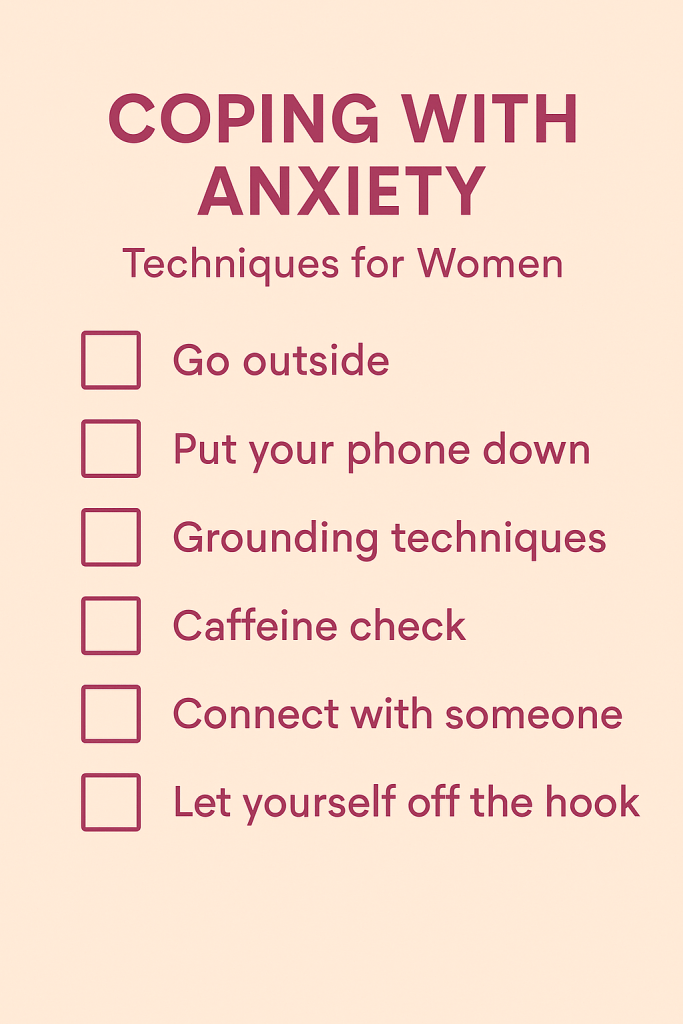
So here’s a non-judgy list of coping strategies that can help when your brain is doing its absolute most:
🌳 1. Go Outside (Yes, Like … Literally)
We’re talking fresh air, grass, sky, real sunlight. Nature slaps in the best way. You don’t have to go full wilderness girl—just sit on your porch, touch a leaf, and breathe for a damn second.
Bonus points: walking. Moving your body gently can lower cortisol and help that nervous energy go somewhere other than your jaw.
📵 2. Put Your Phone Down (We Love You, But Stop Scrolling)
Doomscrolling is anxiety’s favorite snack. If you’re spiraling after reading 300 posts about how the world is ending, it might be time to log out and touch some bark.
Instead, try:
Reading a real book (remember those?) Journaling it out Staring at a wall while you overthink in peace (we’ve all been there)
🧘♀️ 3. Grounding Techniques (aka Reality Checks for Anxious Brains)
When your brain starts spinning out, try the 5-4-3-2-1 method:
5 things you can see
4 things you can touch
3 things you can hear
2 things you can smell
1 thing you can taste
Or—my personal favorite—name five ridiculous things that aren’t your problem today. (The economy. Mercury in retrograde. Susan from accounting.)
☕ 4. Caffeine Check
This one might hurt: Too much coffee can make your anxiety worse. Rude, but true. If you’ve had 3 lattes and your heart’s doing the Macarena, maybe switch to water. Or tea. Or yell into a pillow. It’s all valid.
🤝 5. Connect With Someone (Even if It’s Just a Meme Exchange)
Because you deserve support, not just self-sufficiency.
Anxiety loves isolation. But connection—even tiny, silly, low-pressure connection—can remind you you’re not alone in the madness. Text a friend. Voice note someone. Send a meme. Say “I’m not okay” and let someone hold space for that.
💖 6. Let Yourself Off the Hook
You don’t have to do all the things. You don’t have to be “productive.” You don’t need to justify rest. Sometimes the bravest, most badass thing you can do is nothing, on purpose.
Your worth isn’t measured by how well you hide your anxiety.
Final Word: You’re Not Broken. You’re a Human with a Nervous System.
Anxiety isn’t a flaw. It’s a response. And you are not weak, dramatic, or “too much.” You’re carrying more than most people know—and still showing up.
Take a deep breath. Take your meds if you have them. Take a nap if you need one. You’re doing better than you think.
A couple of weeks ago, I did a post on Why Writers Should Spend Time Offline. That post spoke more generally to the importance of unplugging, but this post focuses more on day-to-day writing/social media balance. There’s also a little bit of a story behind my motivation for both of these posts.
Regardless of where you are in your writing journey, there’s a lot of emphasis on building an author platform these days. You may have even heard that it’s never too soon to start. That’s something I would agree with. Followers will absolutely help you out when it comes to selling or promoting a book, so the sooner you start building your account, the better off you are. But, if you’re not careful, it can be really easy to let that social media eat up a lot of your writing time and energy. This is something I know all too well.
A few months ago, I realized I was spending way too much time online. Checking my phone and social media accounts had become a compulsion. I also found it was getting in the way of my writing and my life. I knew I needed to do something to right the ship. It turned out that when I focused solely on managing my time on social media, my overall internet time cut down across the board. I didn’t want to ditch social media entirely–there’s a lot I like about it–but I did want it to take less time and be less of a distraction. If you find yourself spending more time on social media than you’d like, here are four tips that really helped me cut back without disappearing entirely.
1) Only check in at specific times each day
This was one of my first techniques. I had gotten into the habit of jumping on Twitter and scrolling anytime I had a free minute. Then I’d inevitably find myself following a thread of tweets, doing more research on something I’ve read, or contemplating a response to a mention. I also found myself mindlessly and taking “quick breaks” from writing or work just to see what was happening. So one of the first things I did was limit the time I went on social media. I picked three times a day–once in the morning, afternoon, and night to check-in online. Each check-in was no longer than fifteen minutes long.
2) Limit the devices you’re logged into
Of course, limiting your social media check-ins is a good plan, but it can take some serious self-control. After all, you’re breaking a habit here. I caught myself mindlessly opening Twitter on my browser on several occasions. What helped was to limit the places I was logged into. I work on my computer a lot, so being logged into the social media on there made it way too easy to get distracted and sucked back in. So for me, my phone made the most sense. Now when I use social media, it’s almost exclusively from my phone.
And if you’re thinking, “Well, Meghan, that sounds great, but what’s to keep me from constantly checking my phone?” Here’s tip 2a). Before I started cutting back, I checked social media on my phone so much that I often burned through my battery by the end of each day–sometimes sooner. Perhaps you’ve been there? To keep my phone time and social media time-limited, I found it really helpful to play a game with myself to see how long I could make my battery last. For whatever reason, that really helped me stay off my phone and cut down on social media time in the process. I went from charging my phoneat leastonce a day to only every three days.
3) Only log on when you’re posting something
After a few weeks, I had gotten pretty good at my three times a day check-ins and I was ready to take it to the next level. I decided I would definitely check-in once a day to see what’s going on (like I said, I do like social media), but aside from that, I only log on when I have something to post. This was when the habit really broke for me. Now from time to time, I actuallyforget my once a day check-in.
4) Make your posts purposeful
When it came to posting, I found I spent way too much time thinking of and writing posts. I posted more frequently then than I do now, but I was also sporadic. Some weeks I’d post three times a day and then nothing for a stretch. Once I decided I wanted my accounts to have more of a theme (which is writing), it got a lot easier to post on a fairly regular schedule. That’s not to say that I don’t share other stuff. I do–but I try to focus my regular content on my theme. This has given me a focus and has made it easier to come up with posts.
I also try to plan and write a lot of these theme posts ahead of time, which means I don’t have to constantly remember to write and post. Later app has made doing this on Instagram really easy. Once you have a (free) account you can log in on your computer, type your Instagram posts out, save them, and schedule notifications to be sent to your phone so you don’t forget to post. I used to tap out my really long #WritingWednesday posts in the app, one letter at a time. I love writing those posts, but it took forever! And sometimes my post would be too long and Instagram wouldn’t post it the caption which would make me very sad!
Finding this app has made me so much more efficient and saved me a lot of time. I don’t post nearly as much as I did in the past, but I’m much more consistent, which has helped be maintain a good balance.
Books, games, music, and life — filtered through the mind of a writer, drummer, and philosopher who thinks too deeply about all of it. If it moves something in your chest, I'm interested.


 Professional Book Editing Services for Authors